Monday, 31 October 2016

The decline in newspapers: MM case studies

The New Day
'The New Day' was served as a catalyst to circulate the newspaper industry again by increasing sales as a result, having been described 'the first new standalone daily UK national newspaper for 30 years'.

The article states that '...six million people buy a newspaper in Britain everyday', however obviously as a result of the industry's evolution, there has been a decline. A decline that resulted in a literal one million people turning away from newspapers and instead turning heads to the online world in the last two years, where news is more convenient and free.

The New Day also targeted both males and females from around the age range of 35-55. Their justification for this categorization was because they wanted a more 'modern' audience to perhaps collect these kind of people that have more of an interest and understanding, rather than per say, an 80 year old person.

The New Day however, had failed to reach their target of a 200,000 sales, where they had initially scored a top of 150,000 however that then also too fell to 90,000, and even more to the point that they had to shutdown. The obvious reason for this is the fact other platforms have simply taken over and made things more convenient, cheaper and sometimes free. People would chose to consume news free rather than paying as less as 25p, but as the article states their increase to 50p was 'too much', and this resulted in people not buying their newspapers.

The Guardian

  • 120 million monthly unique browsers - third most read in the world
  • June 2016 daily average of almost 9 million unique browsers - only a third are from the UK - MailOnline with 14 million - Telegraph with 4 million
  • Print circulation of The Guardian is only 161,000 - Daily Telegraph with 472,000 - recently closed The Independent with only 54,000
  • The Guardian lost around £70 million in 2015 
As a result of The Guardian's decline, they intended to combat this by introducing cutbacks up to 20% and planning community events, relying on the investments of The Scott Trust to keep it running as a result too.

The Global website strategy as a result, introducing The Guardian online, may help to some extents, however if they're looking to make revenue from ads, and ads alone, it might not suffice, acknowledging that the majority of users would have ad block enabled. Introducing paywalls on the other hand, might have a more significant impact. The fact that The Guardian have already gathered a loyal user base, means that to an extent they might be willing to subscribe, given that they know getting news from an established institution is much more definitive, reliable, and professional as opposed to any random news page in the Internet.

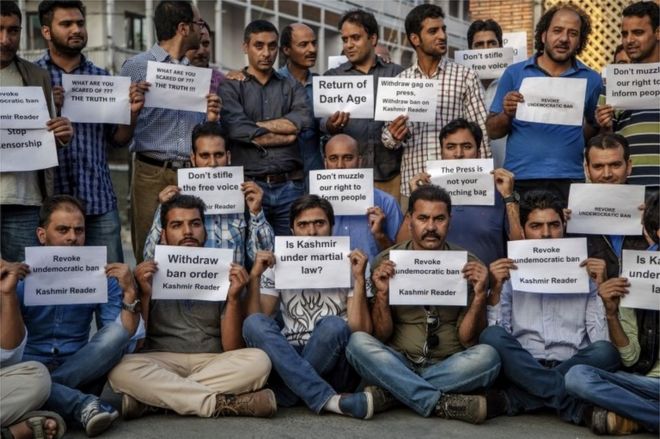
Kashmir newspaper ban criticised


http://www.bbc.co.uk/news/world-asia-india-37559679

The article discusses how peaceful protesters in northern India, Kashmir, have been criticizing the authorities in Indian-administered Kashmir for shutting down a newspaper accused of "inciting violence". The government said the Kashmir Reader (well known newspaper in the region)"contains such material and content which tends to incite acts of violence and disturb public peace and tranquillity". This essentially summarizes how even in some countries the media is limited to things such as even not being allowed to present peaceful protests that do not provoke destruction and propaganda. 
Facts:
  • More than 80 people have been killed in clashes between protesters and security forces and thousands more have been injured in Kashmir
This article is a perfect demonstration of some of the content in media being covered or completely removed as a result of confidential information being released or due to natural censorship. It sort of takes away the moral panic of perhaps needing to know the causes of the protests around them, why its happening, where the source is to all of this, etc. This is especially more significant in 3rd world countries, not specifically India, but to those who are foreign to the digital world and instead consume information from newspapers. But if newspapers are being controlled too, then the information is obsolete in the print industry therefore some consumers may never know of a particular event. 

Kashmiri journalists hold placards during a protest in Srinagar, Indian controlled Kashmir, Tuesday, Oct. 4, 2016.

Sunday, 30 October 2016

Back to the future: were newspaper publishers wrong to go digital?


https://www.theguardian.com/media/greenslade/2016/oct/19/back-to-the-future-were-newspaper-publishers-wrong-to-go-digital

The article discusses in how in theory turning to digital news instead of staying with newspapers might have been a bad idea. The article presents objective statements using facts such as "US newspaper industry digital advertising revenue increased from $3bn to only $3.5bn from 2010 to 2014." as opposed to "... print revenues plunged from $22.8bn to $16.4 bn over the same period, they still represented 82% of total newspaper revenue." Comments were made, describing newspaper websites to be "less than satisfactory" and that it would essentially fail to "sustain our culture". 

Facts:
  • US newspaper digital advertising revenue went from $3bn to only $3.5bn in a 4 year gap between 2010 - 2014
  • US newspaper print revenues decreased frm $22.8bn to $16.4bn over the same period
  • Facts were based on 51 leading US regional newspaper institutions 
  •  25-35% profit margins will never return and be happy with the 5% margins common in other companies
It is without a doubt that an 'only' half a billion in digital advertising revenue between a 4 year period seems to not translate to their linear growth that we would expect as with their presence the digital age that they've taken by storm, but this is most influenced and declined by ad blocks as we know, which news websites can't do anything about as the option to turn it off or on it up to the user. However again, this doesn't conclude with this one reason to mean that going digital wasn't necessarily a good idea, but that it was at least a good move to change with the times and dynamics, and evolve the industry.

From print to clicks, but was that the right direction?

  1. ) Clay Shirky stresses how much 'accountability journalism' is, because the fact that news presented needs to have credibility, accurateness, and editorial judgement with no bias in order to have an ethical share of knowledge and without a definitive answer in a sense.
  2. ) He states that advertisers were not 'overcharged' but instead 'underserved'. As a result for newspapers, Shirky still stands by his opinion that they're irreplaceable, however if advertisers' revenue sparks up then it is an issue for newspapers as the dynamics change, therefore they have to change as a result too.
  3. ) Shirky states that newspapers sometimes don't make sense in what the user wants to consume, meaning for example the jump from one topic to another, as with his analogy; "they just done a crossword puzzle and they seem to really like it, what’s the next thing you’re gonna show them? Is it news from Tegucigalpa? No. It’s another crossword puzzle, because that’s the only thing you can..." Ultimately, people's consumption tend to be more specific as they'd want to for example consume news on the latest attacks in country x, but instead news institutions present different stories, and this just influences the barrier from credible news from established sources to news in the digital age, where they have access in the realm of the Internet to anything else.
  4. ) Shirky explains how news presented before the digital age didn't have much of an impact, that they were forgotten after a few weeks. He uses examples such as a priest molesters crime in 1992, where the offender made victim to almost a hundred boys. Essentially, his point is that if the Internet circulated as much as it does now in comparison, the story would be immensely more widespread.
  5. ) Shirky most disproves paywalls as he sees it to barrier news consumption on a human level, that people should have the right to acknowledge regardless if they've paid for it or not. He states that it "damages" general news and benefits financial news.
  6. ) Social good is a presentation of information being widespread, and this information constitutes people's rights of knowledge as humans, example they should have the right to know that there is a local threat in their area, whether they've paid to consume news or not, or any political event taking place that influences them or others.
  7. ) As far as Shirky says, he states that newspapers are 'irreplaceable', however if they are to change the media landscape of things, they will need to 'experiment' things in their next step. Perhaps to pioneer another platform for the newspaper industry, rather than to completely get rid of them.
  8. ) I think it's very important that brands such as New York Times and The Guardian as a whole to stay in the industry, especially because they're such credible institutions that have a history, and this history reflects their professionalism are reliability that consumers have, and to take this away would be to strip people of their knowledge on a human level.   

Tuesday, 18 October 2016

Trump, Clinton Supporters Differ on How Media Should Cover Controversial Statements

http://www.journalism.org/2016/10/17/trump-clinton-supporters-differ-on-how-media-should-cover-controversial-statements/

Donald Trump and Hillary Clinton supporters are asked whether controversial statements made from both candidates should be blurred out or emphasized more, whether it's offensive and derogatory or not. However instead, both parties have said that news media should draw attention more to the inaccurate statements made, as we know the media to have twisted stories in the past. Voters also feel that news media have given Trump and Clinton too much coverage, and as a result may feel the need to present the truth and only the truth.

  • 6 in 10 voters favor the media emphasizing offensive statements (49% Trump),
  • 45% of Clinton supporters DO NOT want emphasis on offensive statements
  • 77% overall of both Clinton and Trump supporters want inaccurate statements to be emphasized 
It seems that the audience want there to be a clear and fair confrontation, especially regarding politics that shape the future of America as both candidates fight for president. Journalists that have conducted the research also perhaps want to present liable information regarding a serious and 'hard news' topic with no bias. And I think this is perfect in the sense that peoples' true colors in both parties are being shown with these facts and figures that have credentiality, do not lie, and is purely made into results from an objective standpoint. Example, commonly believed that Trump supporters are ruthless, racist, ignorant white people, mostly from the Southern, and fit into the 'offensive' category, while the Clinton supports are thought to be exactly the opposite of this, but shockingly as shown with statistics they are parallel, where nearly three-in-four support the fact that offensive statements need to be emphasized, and all these highlight the negativity. 


Ethiopia bans social media

http://www.theregister.co.uk/2016/10/18/ethiopia_bans_social_media/

Ethiopia's government prohibits social media as its people are suspected to have been 'giving information to terrorists or anti-peace groups.' Protests have obviously been taken as a result of this ban, however protests have been banned too, where the government aims to keep their decisions at stand. BBC commented that Ethiopia's government even told its citizens to not watch any non-Ethiopian Esat or OMN, as they're allegedly controlled by terrorists. Other extents and measures have even been taken, where Ethiopian citizens are warned to stay within 40km of Addis Ababa (Ethiopia's capital).

  • 500 people in Ethiopia have died as a result terrorism
  • Diplomats cannot travel more than 40km (25m) outside of Ethiopia's capital
  • Poverty in Ethiopia - where on average an income of $100 is made in a year
Concerning a 3rd world country like Ethiopia, banning social media is the worst thing they can do as they're already so foreign and isolated from the rest of the world, that taking away their digital privilege is essentially 'stealing' their rights to know information around the world. However, with the increasing number of terrorism threats in Ethiopia's capital social media must be banned, but temporarily which is a respective choice.


Monday, 17 October 2016

Newspapers: the effect of online technology


  • 1.) I completely disagree with James' opinion that news should not be free from the BBC. People from a developed country such as the UK should have every right to be informed about their country's interventions, associations, political affairs, etc, as they're respectively citizens of it. As a result in my opinion James Murdoch is essentially 'stealing' peoples' rights, turning and taking advantage of the news industry into more of a business than a moral landscape where people SHOULD have the option to consume news at a human valued level regardless of whether they've paid or not.
  • 3.) For the sake of journalism and the financial and economic side of the industry, paywalls will obviously help to sustain the industry as a whole, however as stated before it could possibly separate a lot of people as some would be put off by the fact that there's a price to pay in order to consume news, and don't see the point when there's several other news companies that aren't restricted with a paywall. However yet again, paywalls are sometimes necessary to an extent to keep an ongoing circulation, as stated, and needs to keep this mutuality.
  • 4.) "It is so ridiculous if these mainstream newspapers believe that they can "force readership of fee-based news. One can get the same "news" for free almost anywhere on the internet. I'd take a hint from the alternative free weeklies that survive just off their local advertising. I don't think anyone would read them otherwise. These papers are full of paid advertising. The fee model will never work" - Jerry Harris, and as stated earlier, the Internet is subject to having free news, therefore there is virtually no point in paying unless the consumer would want it to be presented with a definitive source and a professionalism taste.
  • 6.) Perhaps the reason for the Evening Standard's increased revenue as the article suggests, is that due to the fact that because there's a decline in the print news audience, the digital audience is now left and free as a result to be targeted by the news company, and they've taken this opportunity to charge news.
  • 7.) I do think there is some extent of hope in print media, as I'd like to think they're more appreciated by those foreign to the digital age, whether it's due to age, where they live, financial reasons, living in a area not within the range of internet access, a 3rd world country, etc. Essentially, the news industry is not a dying media in the sense that people just don't prefer it, its instead just that the digital age is evolving at a very fast rate, making things more convenient and free - and who would like to pay for something when you can access it free on the Internet. This is the main attack, that news institutions such as BBC for example are giving out free news and may as a result be an argument and a plausible reason for making a paywall, that loyal consumers may still pay as their news source is definitive, reliable, and from a professional standard.