Tuesday, 13 December 2016

what does the future of publishing look like?

"What does the future of publishing look like?"


Reuters Building Fleet Street London
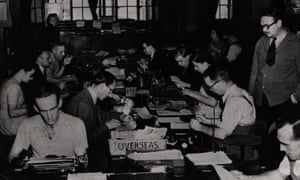
Newsroom 1950s historical, newspaper staff at work

The article discusses the future of publishing in the newspaper industry, and whether it really is sustainable, given the introduction to the new and digital media that has taken popular methods of news consumption, and where it is an alternative method to a more informative and free information, however may obviously lack credibility, reliance and professionalism. Trinity Mirror boss Simon Fox, Guardian columnist Roy Greenslade and former Elle editor Lorraine Candy were asked to share their views about this topic. Lorrain Candy expressed that "I think the demise of print is a myth. There is enough evidence to prove that there will be print, and it will continue to be in many forms and be available in many places." While Simon Fox states "I continue to hope there will be a role for print in 10 or maybe even 20 years, but the challenge is, will the generation that has not grown up with papers migrate to print?" 

In my opinion, the reactions to the given question is not surprising. It is undoubtedly true that print media is dying, however the incertitude about the deeper answers that respond the question is whether it will completely die and be left. Evident, given the mix of black and white answers by people specifically in the print industry, surely perhaps print will live on longer, however cannot be sure to put a definitive answer on whether the younger generation will actually migrate to print again or completely ignore it.

Sunday, 11 December 2016

globalisation - taking it further

Globalisation: taking it further


Media Magazine: Globalisation case study

1.) Google Glass was controversial due to the fact that it invaded and violated people's privacy in a sense, given that the tech is able to take pictures and videos, anywhere, anytime, as long as you're equipped with it, and this level of accessibility threatened people.

2.) As the article states, globalisation has helped people to Google everything that they'd need to know, as with the umbrella term "I'll Google it" or in other words to look it up online. As a result, globalisation has given users the benefit to rightfully consume and acknowledge any information that is posted on the world wide web. 

3.) Globalisation may come to a negative effect, given that for example a pioneering and leading company may dominate a specific market, leaving no opportunity and a gap in the market for their competitors. Examples include Microsoft for example in the computer market. 

4.) Techno-panic defines by which the development of technology causes a moral panic and mass hysteria to the audience, which is similar to the definition of a moral panic, except techno-panic is influenced by specifically technology, while a moral panic is a universal and general definition of the situation.

5.) If major corporations have access to people's personal data on a large quantity, subjectively judging whether it is wrong or right depends more on whether the data is being held with or without the subject's consent, and also depends on the type of data they are holding. Other factors also constitute this judgement on areas such as privacy and how they are going to use this data. However, I think looking at this from a plain lens would obviously come to an agreement that it is a violation of privacy when big cooperations have access to personal data without consent. 

Media Factsheet: Globalisation and capitalism

1.) The phrase 'a global village' originated when theorist Marshall McLuhan used it to describe that the world that has been “shrunk” by modern advances in communications.

2.) Slavoj Zizek argues that while globalisation of capitalism helps developing countries on a financial level, this may effectively blind people from other issues at hand such as the gap between a very poor country and a very rich country, so there isn't a resolution being meet where there is equality. This is perhaps a link to a Marxist point of view, where the belief is that there is a social class of elites who depict the outcome of a less social class, less monetary value state, and is put under full control by them.

3.) The term 'capitalism with a conscience' as Zizek describes, the article writes "He argues that the media reinforces and naturalises
the ideology that making money is the right way of conducting
businesses, but at the same time allows people to feel less guilty
about how these goods are produced."

4.) As their official websites states, (RED) has a simple mission, 
to make it easy for people and businesses to join the fight against the deadly virus called AIDS. Descriptions of the virus, such statistics such as death victim to 35 million people since 1981 have been presented on their website.

5.) It is very hard to put a definitive judgement on whether RED campaign is just purely profit-driven or for ethical reasons, but based purely on the media facsheet article's insight, it seems that RED 'has spent more on its advertising than it has donated to AIDS charities and there has been a backlash about the lack of progress that the campaign has made.' 

Tuesday, 6 December 2016

freedom of speech

"WORLD MEDIA NEEDS TO TAKE NOTE OF FREEDOM OF PRESS BEING CURBED IN PAKISTAN: RAHUL JALALI"

Rahul Jalali, a journalist, said the placing of a journalist of the Dawn newspaper on the Exit Control List on the instructions of the Prime Minister’s Office is a direct attack on freedom of press in Pakistan and needs to be condemned by the global media. The newspaper asserted that it stands by the report and accused the government of “scape-goating the newspaper in a malicious campaign.” As a result, it is said that the President of Pakistan and the Army was upset about whatever Jalali wrote, despite stressing that "the report had not suggested anything untoward". 

The issue of blocking the freedom of speech in certain countries, such as Pakistan for secular reasons or not, is a perfect demonstration of something similar to the digital divide that some countries still are subject to. That they might have access to computers and Internet to comment whatever and whenever, but they're so restricted by their own government that it might get removed and victims of an illiberal and injustice system as a result. Perhaps some people do have access to the Internet, but they cannot experience the full extent of it.

website labelled fake news

http://www.wnd.com/2016/12/website-labeled-fake-news-threatens-to-sue-major-u-s-newspaper/

WEBSITE LABELED 'FAKE NEWS' THREATENS TO SUE MAJOR U.S. NEWSPAPER

The article discusses how one of the websites The Washington Post labeled “fake news” in a November story demanded a retraction and threatened the paper with a defamation lawsuit in a demand letter Sunday. Accused of supplying fake news by a lawyer for 'Naked Capitalism', both the company's brand image and their company as a whole to potentially be sued is at risk. 

  • Naked Capitalism is a finance and economics blog started in December, 2006, with a stated goal of “shedding light on the dark and seamy corners of finance.”
  • Naked Capitalism accuses WaPo to be provoking fake Russian propaganda news
Fake news is a perfect demonstration of why it is not always a good idea to consume information on the world wide web on everything you see, even if it is presented by a trusted and credible institution, as the understanding of how manipulative of the media is, is always true to some extents. As a result, this then allows consumers to acknowledge and be cautious of how they are to tackle this problem in the future, and to not be "fed" information.

© Jonathan Ernst

Monday, 5 December 2016

gone too far review

Gone Too Far, in short, is a film about the embarrassment and a goofy "yoyo" of emotions that two brothers go through - one native to South London and the other foreign with a funnily Nigerian tongue, who go through more things on the way than to simply pick up some grocery at a corner store for their mum... Their journey revolves around when the pair are forced to spend the day together on their Peckham estate Yemi is forced to confront local bullies, the unattainable girl of his dreams and his own African heritage, eventually teaching both of them the values of family and self-respect.

This journey, which then had the opportunity to demonstrate certain stereotypes of black minorities involved in certain anti-social behaviour such as being gang affiliated was definitely pushed in by the writer Bola Agbaje, who had discussed the ethos of her writing in this film. Perhaps this is an introduction into the influences life offers someone, juggling between a person's love life, sports, work, essentially what constitutes their stress and frustration, and this is perhaps what Agbaje wanted to subjectively express too, as said in her Q&A session. The fact that Yemi refused his foreign brother, and that his stroked ego couldn't afford to be lost in front of other characters presents us the social norms of London life, especially in a "ghetto-ish" area, where reputation is valued. The characters are generally good; they have chemistry and are relatable, purposely more to a viewer that is from London, specifically the south, and all adds up to make a more engaging and less passive viewership. However, in vice versa there is the exception of the London slang, whom presumably cannot be understood by foreign viewers to London, and as a result could remain a bit confused. 

This then comes to the conclusion that ethnic minorities should have the right to represent anyone, as it is a subjective representation view, and instead should create to express and not impress. It is also however objectively true that movies should be made regardless of the subjective opinions that disagree with it, as it is undoubtedly made for monetary reasons more than for the ethos of film making, as with mainstream Hollywood nowadays, example, Fast and Furious franchises. In other examples however, there is the slightly deragotry representation of certain groups such as the Muslim community, who is subject to discrimination and prejudicism, predominantly set catalyst by events such as the Twin Tower 9/11 bombings. Films such as American Sniper, United-93, create a sense of moral panic as people have been "fed" this kind of information although they may not necessarily be true. The realism aspect to it is what is the most affecting, hence the audience can relate more to it. Example, a south-east Londoner may feel more attached and have a significant impact simply because they're able to relate more, just as the relation between an American audience and American Sniper, United-93, audiences that feel that they're in the category. 


Sunday, 4 December 2016

NDM News: Globalisation


Globalisation and news: blog task

1.) I definitely do think that America has a huge influence in other countries' news, given for example, the presidential election of 2016 between Donald Trump and Hillary Clinton, which has concerned people on a global scale, even though they're not subject and being affected by the result. On a lower scale however, would be the EU referendum would also be another example, however wasn't necessarily as anent.  

2.) With ever increasing and faster access to the Internet, twinned with the unstoppable explosion of the Web, a global platform has been created. A platform that has nurtured traditional media and introduced a variety of new media, including media created by the audience itself. This platform is available to anyone with connection to the Internet and creates a 'surveillance' for consumers. It is also a demonstration of freedom of speech, where users have the right to acknowledge any information that is posted on the Internet.

3.) Globalisation has both benefited and put news institutions at a disadvantage sometimes close level, and sometimes at a huge level. A disadvantage would obviously be the sourcing in how institutions are presenting them in, and whether if it has been presented by another institution already, etc. Essentially, point is that the news industry is a competitive industry.

Friday, 2 December 2016

islamphobia plan

Islamophobia/xenophobia and the media
Introduction:
Will discuss the impact on the Muslim community and the result of their retaliation due to it, such as even more cases of terrorism.
Will introduce media texts such as films like mainly American Sniper and how a soldier is seen as a hero, but may be seen as a terrorist to Islam and vice versa. Will introduce United 93 as a sub text and Historical text to reinforce and support my ideas on the stereotypes and prejudice/discrimination which Islam is victim to.
Main text:
American Sniper, a film based off a real occurrence, is about a top sniper sent to protect his comrades in the battlefield, and is seen to be a hero at least from the eyes of an American. In the film the typical representations of Islamists/Militants/Radicals/Extremists are presented as the bad guys, often always seem to be holding some kind of weapon in the film, even though from a neutral standpoint, they're just retaliating to the attack, just like Americans are terrorists to Islam, and Islam are stereotypically terrorists to the common American. Main point to discuss is the “one sided” and “black and white” binary representations between good and bad, even though they might not have been necessarily true.
Also as the title suggests, "American" Sniper, we see the picture through American lenses, supported by their cultural style and political language. Where the strongly Native American believes all Muslims are a threat and are mostly portrayed as the bad guys. Even in reviews by respected institutions, it is said I’m not going to fault Kyle’s view of his enemies as representing a “savage, despicable evil,” but I do fault Eastwood for making what is, essentially, a propaganda film. Clint Eastwood cleverly tries to attract a mainstream cinema audience and get them to engage with the politics behind it, and as a result catalyses the topic of Islamophobia. I will discuss perhaps there are some influences to this such as a business decision.
Theories:
·         Binary opposition between good (America) and bad (Islam)
·         Hypodermic needle model of marginalizing the whole of Islam
·         Tessa Perkin’s theory of stereotypes
·         Hegemonic views
Key scenes and textual analysis of American Sniper:
RPG Kid scene –
The scene demonstrates a quite controversial and propaganda sparking idea by Clint Eastwood, as several other film reviews have said, where a kid is almost predisposed to pick up the nearest weapon and fire anything on site - they are that brainwashed, and I will discuss this in further detail with theories and analysis.


RKG Grenade scene –
A Muslim mother sends her martyr child to bomb American soldiers, but the child is sniped by Chris Kyle, and as a result the mother risks her own life to fulfil the deed. I will discuss the implications and controversy that surrounds this scene like similarly like the one before, and will use film reviews from institutions to back up my subjective ideas about this.
Quotes:
“Words such as ‘fundamentalist’, ‘extremist’ and ‘radical’ are regularly used in
Apocalyptic headlines across all sectors of the British press. They create the impression
of a mounting universal conspiracy directed against British society by an organised
and coherent army of bloodthirsty agents. It is evidence of a tendency to view all
Islamic movements as originating from the same root and as being equally hostile to
Britain.” With this quote I will discuss the definitions and their associations with the media, such as purposely using these words that speak controversy to simply make headline views, etc, and how this has a negative impact from something cynical.

“There are 175 mosques in NYC. There are 6000 churches in NYC. And there are about 1000 synagogues in NYC.” I will discuss the impact derogatory stereotypes have had on American citizens who follow Islam and how they’re almost feeling “unwelcomed”.
“The leading cause for Islamophobia is usually misinformation or total lack of information based on the religion. Islamophobic people are not likely to be willing to educate themselves about their fears or spend time around any Islamic people.” I will be discussing the demonstration of some media theories such as stereotypes and the hypodermic needle model where the media is responsible for this, “feeding” viewers a bad image.
Issues and debates:
Sam Harris on a podcast, expressing objective statements on Islam and Political Correctness
Christopher Hitchens’ talks about Islamphobia – “Is fear of Islam racist?”